Supernova Remnants
Copyright © 1996 Garret Wilson
- A Light from Heaven
- Putting New Ideas to Use
- Neutronization and the Formation of a Supernova
- Leftovers
- Who Cares?
- Works Cited
- Other Related Sources
A Light from Heaven
It was the 4th of July, almost 1000 years before the United States would celebrate their first Independence Day. In 1054, while most of Europe went about their daily lives with little scientific inquiry, others around the world noticed a star in the sky that suddenly became brighter than all the other stars in the sky. This had never happened before, and those who noticed it knew that something new was occurring -- that is, new to recorded history.
Chinese astronomers called it a "guest star" in the Constellation of Taurus. The Muslim world took note of it, and recorded sighting it. On the other side of the world, in what is now New Mexico, one of the Ansazi ancestors of the Hopi noted a new, bright star, and drew its picture on the nearby cliff walls. (Thorne, 235)
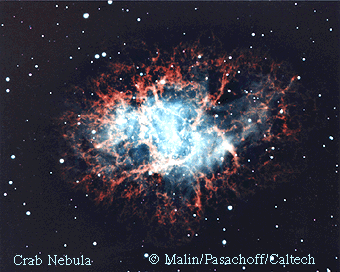
This occurrence was the formation of what scientists today call supernovas. As the cosmos continually evolves, stars with a certain mass, age, and environment run out of fuel, shrink, and then violently explode. The 1054 supernova was so bright that one could read by its light during the night. (Thorne, 237) It left remains that one can still see today through a telescope: the Crab Nebula. Shaped remotely like a crab, these remnants of that spectacular occurrence will remind us of the star's death for eons to come.
Putting New Ideas to Use
In 1925, a man named Fritz Zwicky was hired by the California Institute of Technology to teach and do theoretical research on the quantum mechanical structures of atoms and crystals. Zwicky was fascinated by supernovas. Supernovas were not so new anymore, having been observed by such famous people as Tyco Brahe in 1572 and Johannes Kepler in 1604, but they were not understood.
Zwicky wanted to find the cause of supernovas, and in 1932 he thought he had found what he was looking for. In February of that year, James Chadwick, a member of the experimental team of Ernest Rutherford (famous for the Rutherford/Bohr model of the atom) was able for the first time to successfully knock neutrons from an atom, proving that Rutherford was correct in predicting the existence of neutrons. Neutrons, said Rutherford, are neutral particles (hence the name) with the same mass as protons. Both neutrons and protons are tightly bound together in the nucleus of an atom, while one or more electrons surround the nucleus.
The validation of the existence of the neutron was just what Zwicky had been looking for. He and Walter Baade reasoned that, what if a normal star could be made to implode until it was very dense -- as dense as an atomic nucleus? In this case, they supposed, the core of this star would be so dense that gravity would compress it tighter and tighter until its material would transform into a "gas" of neutrons. Zwicky called this a "neutron star."
Furthermore, the gravity would be so intense that not only would the size of the star be reduced, but its mass would be reduced. Where would the rest of the mass go? Zwicky reasoned that ten percent of the original mass would be converted into explosive energy which would radiate out into space. If the mass of the core of the shrunken star was about the same as that of the Sun (one solar mass), and ten percent of it were converted into energy, it would produce 1046 joules. Zwicky thought that this would be just what was needed to produce the incredible phenomena known as supernovas. (Thorne, 164-171)
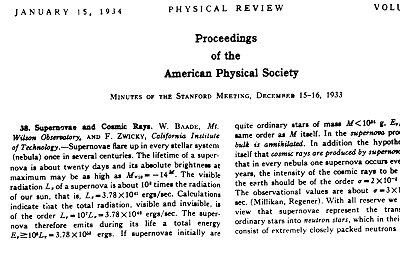
Although they had little evidence other than supposition for their ideas, Zwicky and Baade presented their ideas together at a meeting of the American Physical Society at Standford University in 1933, the year after the neutron was experimentally shown to exist. Physical Review published an abstract of their speech the next year. Although the phenomenon of supernovas had long been acknowledged, this was the first time anyone had called it a "supernova." Baade and Zwicky turned out to be correct in their assumption that the formation of objects called, "neutron stars" were responsible for supernovas, but it would be around 30 years later before scientists would illustrate theoretically how this could occur, and even longer before the discover of pulsars (spinning, magnetized neutron stars spinning inside old supernovas) would show by observation that they had been correct. (Thorne, 173-174).
Neutronization and the Formation of a Supernova
Supernovas come in two varieties, Type I and Type II, based upon how they form. Type I supernovas form when a particular kind of star called a white dwarf has a binary partner, and the white dwarf accretes matter from its partner until it approaches a critical limit, called Chandrasekhar's Limit. Type I supernovas do not leave remnants (Wheeler).
Type II supernovas arise from stars that have a mass many times greater than the Sun. These stars also have much higher temperatures and pressures. Under these conditions, they quickly use up their store of hydrogen. "Quickly" is, of course, a relative term: these stars still take millions of years to run out of fuel. It first converts most of its hydrogen (the lightest element, usually consisting of one proton and one neutron in its nucleus) into helium (the next lightest element, usually consisting of two protons and two neutrons in its nucleus). After most of the hydrogen is converted, the gravitational pull of the star fuses the resulting helium together to form heaver elements. This cycle repeats, creating a very dense iron core surrounded by layers of silicon, oxygen, neon, carbon, helium and hydrogen. (Textbook, 445).
As the start continues to fuse the remaining elements into heaver elements, including iron in the core, the core continues to gather mass. When the core reaches 1.4 solar masses (referred to as Chandrasekhar's Limit), its mass is so great that the outward pressure of the iron atoms cannot resist the pull of gravity, and the entire core shrinks under the gravitational force. At this point, under the great pressure, the electrons in the interior of the star meld with the protons in the iron nuclei. Since electrons have a negative charge of one, and protons have a positive charge of one, they effectively "cancel each other out" (Thorne, 238). This brings about neutronization, or the creation of neutrons from the reaction of protons and electrons.
As more electrons and protons are converted to neutrons, there are less of the former to counteract the force of gravity. When this occurs, the entire star suddenly collapses under its own weight. It only takes about a second for the core to shrink from thousands of kilometers to about a 50km radius (Fix, 445). The result of this process is that the central core of the star essentially becomes a large atomic nucleus consisting of neutrons, held together by its own gravity. This central core of neutrons is now what Zwicky named a neutron star long before we knew their details, or if they even exist. If the core is massive enough, it will form a black hole (Burrows).
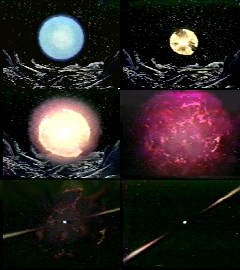
The neutron star is about as dense as the nucleus of an atom. If one were to take a teaspoonful of a neutron star, it would weigh about the same as a mountain on Earth! (Thorne, 239). It is because of this density that its gravity cannot compress it any further. The rapidly collapsing outer core meets the dense, inner core which cannot be compressed, and literally bounces off of the central core and rebound into space at one sixth the speed of light. Neutrinos formed in the collapse assist the explosion by heating the gasses which help push the material forward. (Fix, 446). Within a few hours, the outer layers of the star are ejected violently through space at up to 20,000 km/s, producing the phenomenon which (again, named by Zwicky) we call a supernova.
Leftovers
As the outer layers of the newly-formed neutron star fly through space, they create a hole in the interstellar medium (ISM) that keeps expanding until it is several hundred light years in diameter. Inside this "bubble" in the middle of space, the matter is very hot: usually several million degrees Celsius. The matter is not very dense however, having sometimes only one proton in every liter of volume (Burrows).

Einstein Observatory High Resolution Imager (HRI) image of Tycho's Supernova Remnant.
As the bubble expands, it pushes the ISM farther away, and the gas is therefore densest in a layer around the outer areas of the bubble, where it forms a sort of shell. Small pockets of this compressed gas are denser and therefore cooler. These pockets of gas radiate ultraviolet and visible light, and hydrogen and other atoms create emission lines that can be detected from Earth. The extremely hot area of the supernova remnant inside the bubble is radiated in the form of X-rays. The expanding supernova transfers energy to interstellar dust particles, which produce infrared radiation. (Fix, 448). This bubble expanding in the ISM produces supernova remnants, what is left of the violent supernovas. These remnants continue to spread through space, traveling slower as time passes. Eventually, after tens or hundreds of thousands of years, the remnant merges with the interstellar gas. (Fix, 450).
Since the ISM is not evenly distributed, the bubble does not expand in a uniform manner, giving rise to three basic varieties of supernova remnants. The first, called Shell-Type remnants, appears more like the bubble that created it. The large shell of supernova matter spreading the interstellar dust is visible as a ring. This occurs because, although the distribution of matter around edges of the bubble may be relatively uniform, from our viewpoint the curved edges of the three-dimensional shell appear to contain more hot gas than the middle. The term for this is "limb brightening" (Keohane, "Remnants").
Crab-Like remnants, also called plerions, do not appear shell-like; their centers seem to be filled. They contain a pulsars, which are neutron stars which emit regular bursts of radio radiation. These pulsars also emit streams of very fast-moving material (Keohane, "Remnants"). The Crab Nebula is an example of a plerion.
The last type of remnants are referred to as Composite Remnants. Many classification schemes have a catch-all category, and Composite Remnants is such a category. It include the many supernovas that have aspects of both Shell-Type and Crab-Like remnants. It may appear shell-like or crab-like when viewed from different portions of the electromagnetic spectrum. It is possible that in some cases this is caused by the shock wave continuing to spread the ISM, while the hot gas of the supernova have fallen back toward the center of the bubble (Keohane, "Remnants")
The Age of Remnants
If the supernova that causes a certain remnant is actually observed, it is quite simple to determine the age of the remnants. However, most supernova remnants we see were not caused by supernovas which we have witnessed. In this case, there is a way to estimate the age of a supernova remnant through extrapolation.
Remembering that, after the explosion of a supernova, it forms a bubble which spreads through space at a certain rate. In a certain amount of time, the bubble will have expanded a certain distance. Watching a supernova remnant over time can give us an idea of its rate of expansion. For example, if one observed a supernova remnant 20 years ago, and then observes the same remnant today, it will have expanded. Superimposing the second image over that of the first would result in a smaller bubble inside a larger bubble. One can then measure the amount of expansion over that 20 year period.
In this example, let's say that the supernova expanded by five percent. The rate of expansion can therefore be determined in the following manner:
rate = 5% / 20 years = 0.25% per year
Common sense tells us that the remnant expanded 100% since the actual supernova. Since distance = rate × time, algebra tells us that time = distance / rate. You can therefore determine the age (time) of the remnant by the following formula:
time = 100% / (0.25% per year) = 400 years
These calculations assume that the speed at which the remnant is expanding has remained constant, and therefore give us the maximum age of the remnant. Remnants, after all, only slow down their expansion; they do suddenly expand faster than before. Scientists believe that by measuring the expansion rate in the fast-moving parts of supernova remnants they can determine a relatively accurate age (Keohane, "Age").
Who Cares?
Supernovas are violently interesting. Their remnants are beautiful. But their usefulness goes far beyond the "fireworks" and the visual effects. They are, in short, essential for our very existence.
Soon after the Big Bang, which created matter and time as we know it, the only elements which existed were light elements, such as hydrogen and helium. Life on Earth is composed of heavier elements, such as carbon. Organisms breath oxygen, another heavier element. The earth itself is made up of many heavy elements, such as iron. It is probable that these heavy elements -- the ones that make up you and me -- were actually created inside stars and in the violent collapses before a supernova.
The supernova remnants, as they move through space and blend into the interstellar medium, are responsible for distributing these heavy elements. The remaining clouds of gas, left from the interstellar medium combined with the heavy elements from the supernova remnants, eventually cool and collapse to form the interstellar clouds which are responsible for creating other stars and planets (Burrows). This means that all of the planets in our solar system are made up of material from supernova remnants. Every atom in the Earth, the trees, and your body were all once part of the inside of a star.
Once upon a time, billions of years ago, a star died. In a brilliant supernova, its violent death created remnants that would eventually form something wonderful. And we were there when it happened.
Works Cited
- Burrows, David N., "Supernova Remnants", Department of Astrophysics, Penn State University, (available on the World-Wide-Web at http://www.astro.psu.edu/deptinfo/research/Ground_Analysis/supernova.html).
- Fix, John D. 1995, Astronomy: Journey to the Cosmic Frontier, St. Louis, Missouri: Mosby.
- Keohane, Jonathan, "How to find the age of a Supernova Remnant", X-Ray Astrophysics Branch of the LHEA at NASA's Goddard Space Flight Center, (available on the World-Wide-Web at http://lheawww.gsfc.nasa.gov/users/jonathan/outreach_pages/snr_age.html).
- Keohane, Jonathan, "Supernova Remnants", X-Ray Astrophysics Branch of the LHEA at NASA's Goddard Space Flight Center, (available on the World-Wide-Web at http://lheawww.gsfc.nasa.gov/users/jonathan/outreach_pages/snr_page.html).
- Thorne, Kip S. 1994, Black Holes & Time Warps, New York, N.Y.: W. W. Norton & Company.
- Wheeler, J. Craig, "Supernovae Research Group of the University of Texas Astronomy Department", Supernovae Research Group, University of Texas Astronomy Program, (available on the World-Wide-Web at http://tycho.as.utexas.edu/SN/).
Other Related Sources
- Green D.A., 1996, "A Catalogue of Galactic Supernova Remnants (1996 August version)", Mullard Radio Astronomy Observatory, Cambridge, United Kingdom (available on the World-Wide-Web at http://www.mrao.cam.ac.uk/surveys/snrs/).